
The Impact of Incorrect Insulation in a Transformer
Introduction
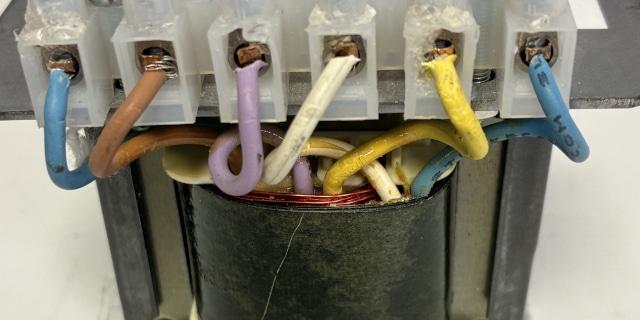
Separation between circuits is a fundamental principle that keeps different circuits and potentially the user safe from high voltages, and it is a key part of the standard, such as IEC 61010-1. One of the most common components used to isolate circuits is the transformer, which ensures the seamless transfer of electrical energy between circuits via electromagnetic induction. It typically comprises a ferrite core, where wires are wound and separated by specialised insulation tape.
Enquire Here


Background
A customer of ours submitted a 65kVA, 3-phase transformer for use inside a product in an industrial environment for safety evaluation. The product testing went well until the insulation between the primary and secondary circuits was tested. The insulation was tested for its electric strength. During these tests, there shall be no breakdown of insulation over 60 seconds for the set test voltage determined by the various factors detailed in the standard; in this case, it was 3kV.
It was found that an electric breakdown occurred after 10 seconds when the voltage was applied between the primary and secondary circuits.
The Problem
The investigation into the failure was quickly identified, as there was a visible arcing between the windings of the transformer. To investigate the failure, the customer sent the data sheets of the components that made up the transformer. After careful evaluation of the data sheets, it was evident that the insulation material separating the windings from the primary to secondary was not sufficient for the electrical strength test.
The material used was correctly selected for its application, heat dissipation, flammability, etc. However, it was not suitable for providing the correct insulation for the elevated high-voltage tests as required by the standard.
The customer confirmed that this was overlooked during the design stages, as they had designed the product for operation rather than meeting safety standards.
Enquire Here

Consequences
Without knowing the correct insulation that needs to be used between the primary and secondary circuit within a transformer, it can lead to potential electrical failures such as:
- Degradation of the insulation leading to component failure and overheating
- The deterioration of insulation may increase the risk of arcing, which may cause a fire hazard
- Deterioration of the insulation material, which reduced its dielectric properties and potential electric shock hazards
- Partial discharge activity within the transformer, leading to tripping of the supply breakers
Conclusion
This case study emphasises the significance of understanding the consequences of not sourcing the correct materials and ensuring the components are not just acceptable from a performance point of view, but also from a safety perspective.
In this instance, the customer designed a very robust product that outperformed its competitors. However, they left product safety until the very end of the design process and did not understand the requirements of the safety standard.
Ensuring component testing throughout the product design can mitigate risks, enhance reliability and safety.
The lesson here is to understand the process and implications of the selection of components and materials for safety compliance.
Enquire Here
